

States where cursive handwriting is still taught in schools
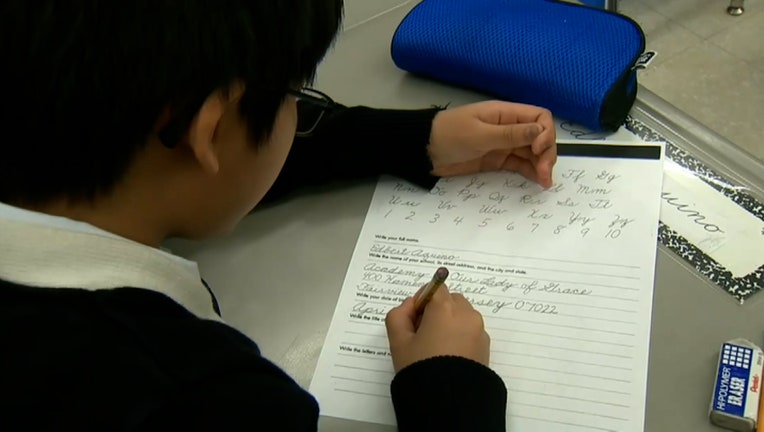
More than half of all U.S. states now require some form of cursive instruction in public schools, after years of decline due to Common Core State Standards. (WNYW)
As the digital age races toward AI and other major developments, the teaching of handwriting – specifically, cursive handwriting – is continuing its comeback in America’s public schools.
More than half of all U.S. states now require some form of cursive instruction in public schools, after years of decline due to Common Core State Standards.
Why did some schools stop teaching cursive?
The backstory:
Starting in 2010, the Common Core State Standards were adopted by most U.S. states with the goal of better preparing the nation’s students for college or a job.
RELATED: New ranking shows the best and worst states for teachers
They established benchmarks for reading and math, replacing education goals that varied widely from state to state.
The Common Core standards didn’t include cursive in the recommended curriculum, leading to a big decrease in cursive being taught.
Cursive makes a comeback
In recent years, requirements for cursive instruction have increased, even though Common Core standards are still used in many states.
RELATED: Police face backlash for using electric shock gloves in Nebraska schools
By the numbers:
In 2016, 14 states required schools to teach cursive writing. By 2019, 20 states had enacted legislation requiring it, according to mycursive.com, a website that tracks cursive writing requirements nationwide. By 2024, it was 27.
Which states require cursive instruction?
Local perspective:
According to the American Handwriting Analysis Foundation, at least 31 states in the U.S. require some form of cursive instruction, though FOX Local could only independently verify 27. It's worth noting that just because it's not required, doesn't mean it's not being taught. Several states give local districts discretion on whether to teach cursive.
Why is handwriting important?
Why you should care:
While some educators believe that cursive handwriting is becoming obsolete and shouldn’t be a priority in an increasingly digital age, other experts say handwriting in general is notably better for learning than typing or using point-and-click devices.
"Handwriting is hands down much better for learning for people of all ages, starting from very young," explained Zoe Smith with the University of Denver. "We're talking like 2 years old preschool all the way up through adulthood.
"One of the reasons handwriting is better for learning is really the ability to physically put pen to paper lights up more areas of our brain," she continued. "It helps us remember things better. It helps younger kids learn their letters and recognize their letters faster and more efficiently, and then can help even college age students in remembering lectures at higher rates.
"What typing is not doing is it's not physically tracing letters for memorization of those letters. There's a lot of gross motor movements that are really important to learning and engagement for young kids. And so when you're just typing the letters, you're not learning them because you're not physically making them on a page."
The Source: This article includes information from the American Handwriting Analysis Foundation, the University of Denver’s Zoey Smith, the Associated Press, and previous FOX Local reporting. Kelly Hayes contributed.