

Iran latest: Pakistan tries reviving US-Iran peace talks, blockade remains in effect
A new round of peace talks between top U.S. and Iranian officials remains elusive as Pakistani leaders continue working to get both countries to return to the bargaining table.
A significant gap remains between U.S. and Iranian demands that Pakistani-led mediators are trying to bridge, a regional official told the Associated Press on the condition of anonymity.
Iran is demanding an end to the U.S. blockade of its shores as a prerequisite for any new talks. Meanwhile, President Donald Trump planned to dispatch envoys Steve Witkoff and Jared Kushner to Pakistan for negotiations, only to change course over the weekend and direct them not to go.
The U.S. military's Central Command provided an update on the blockade, saying they have forced 38 ships to turn around so far.
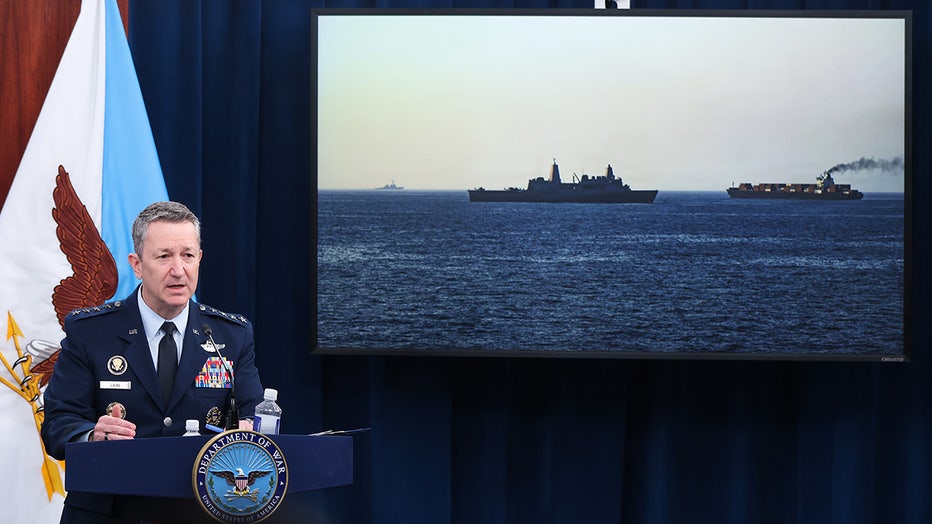
Chairman of the Joint Chiefs of Staff Gen. Dan Caine speaks during a press briefing at the Pentagon on April 24, 2026 in Arlington, Virginia. President Trump announced that the Israel-Lebanon ceasefire has been extended by three weeks on Thursday whi
Here's the latest from Monday:
Stopping Iran from getting nuclear weapon a top issue for U.S.
8:50 p.m. ET - Secretary of State Marco Rubio described Iran's ability to obtain or develop a nuclear weapon as a "fundamental issue" of the ongoing peace negotiations.
"There’s no doubt in my mind that at some point in the future, if this radical clerical regime remains in charge in Iran, they will decide they want a nuclear weapon," Rubio said in an interview with FOX News.
Rubio's response came after a question about Iranian leaders' recent proposal that it let traffic pass through the Strait of Hormuz again in exchange for the U.S. lifting its blockade and ending the war, while discussions about the country's nuclear program would be postponed.
Iran's nuclear program takes center stage in U.N. talks
4:58 p.m. ET - A review of the United Nation's Nuclear Nonproliferation turned into another battleground between the United States and Iran as the countries clashed over Tehran's program.
Monday's confrontation stemmed from Iran's role as one of the 34 vice presidents of the conference, which is conducing a review of the treaty's implementation that happens every five years.
Iran has signed onto the treaty, but has not allowed access to inspectors from the International Atomic Energy Agency since the U.S. bombing in last June.
While acknowledging the differing views among nations of Iran's nuclear ambitions heading into the meeting, U.S. Secretary of State for arms control and nonproliferation Christopher Yeaw said Tehran has shown "contempt" for the treaty's requirements.
Russian President Putin pledges support for Iran
2:29 p.m. ET: During a meeting between Russian and Iranian officials, Russian President Vladimir Putin said Mosow would do everything it can to support Tehran amid the ongoing diplomatic efforts between Iran and the U.S.
Putin met with Iranian Foreign Minister Abbas Araghchi in St. Petersburg on Monday. "I would like you to convey my most sincere words of gratitude and to confirm that Russia, like Iran, intends to continue our strategic relations," Putin said. "We will do everything that is in your interest, in the interests of all nations in the region, so that peace is reached as soon as possible."
National security team discussed Iran's proposal
1:43 p.m. ET: White House Press Secretary Karoline Leavitt confirmed that Trump's national security team met and discussed Iran's proposal on reopening the Strait of Hormuz.
No additional information was concluded, but said the president would address it at a later time.
UK does not support US blockade
11:50 a.m. ET: While concluding Iran is holding "the rest of the world ransom," Stephen Doughty, minister of state for Europe and North America said the United Kingdom doesn't support the U.S. blockade of Iranian-based vessels at the Strait of Hormuz.
He noted, ships must safely travel through the strait unimpeded "and that includes no tolls, no security risk and, of course, adherence to the international laws on freedom of navigation."
House minority leader criticizes Trump
8:34 a.m. ET: House Minority Leader Hakeem Jeffries again criticizes President Trump in a social media post.
Jeffries took to X to discuss the closing of the Strait of Hormuz, gas prices and the impact on taxpayers in Trump's "war of choice," according to the post.
Putin to meet with Iran
7:55 a.m. ET: Russian President Vladimir Putin is scheduled to meet with Iranian Foreign Minister Abbas Araghchi in Russia on Monday.
The meeting comes a day after President Trump canceled the planned trip to Pakistan by a U.S. delegation for peace negotiations.
"The importance of this conversation is hard to overestimate in terms of how the situation around Iran and in the Middle East is developing," said Kremlin Spokesman Dmitry Peskov.
Iran wants to reopen the strait without nuclear agreement
6:18 a.m. ET: Iran is offering to reopen the Strait of Hormuz without coming to an agreement with the United States on their nuclear program.
According to regional officials, the proposal which was passed to the U.S. by Pakistan, Iran is said they want the U.S. to end its blockade as part of the proposal.
President Trump has continued to insist Iran's nuclear program is part of the deal that includes reopening the Strait of Hormuz.
The Source: Information for this article was taken from The Associated Press and FOX News. This story was reported from Orlando.