

Arizona governor candidates clash over water, taxes, and data centers
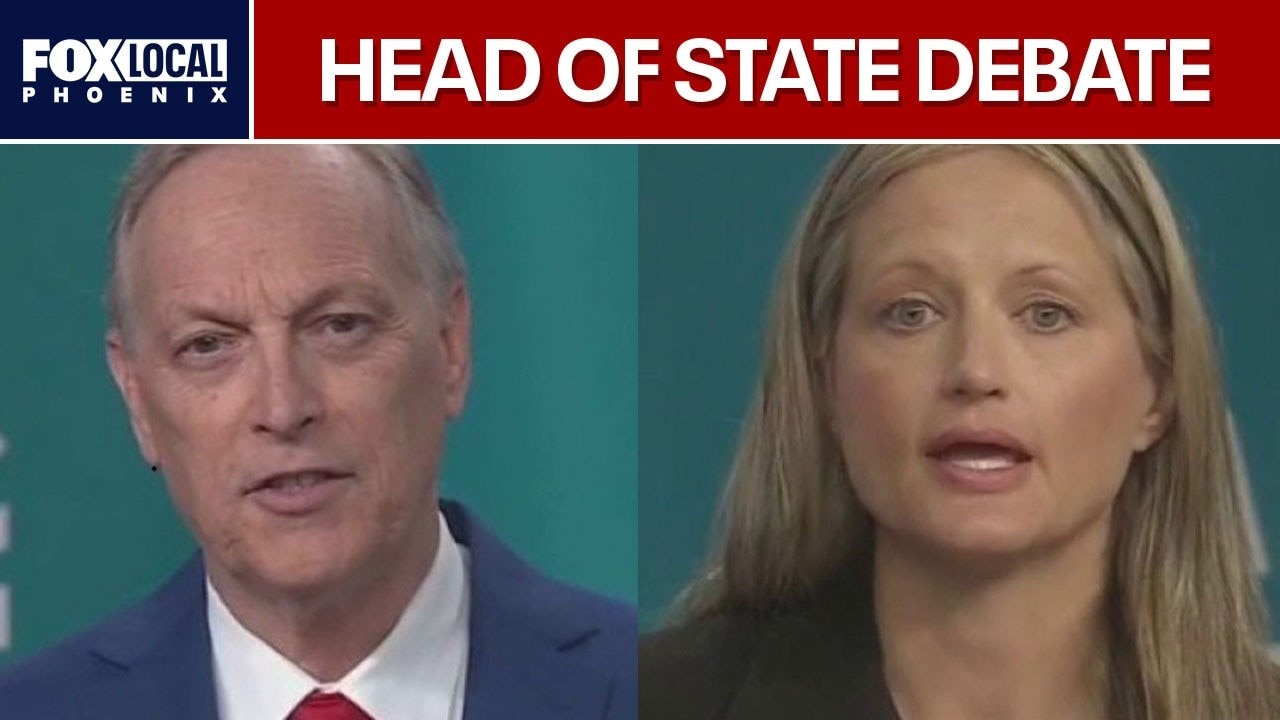
Biggs, Hourihan clash in Arizona governor debate
Republican Andy Biggs and No Labels candidate Teri Hourihan debate economy, healthcare, and water issues.
PHOENIX - Republican Andy Biggs and No Labels candidate Teri Hourihan took the stage Oct. 6 in a gubernatorial debate organized by the Citizens Clean Elections Commission, clashing over economic policy, healthcare funding, state spending, and water security.
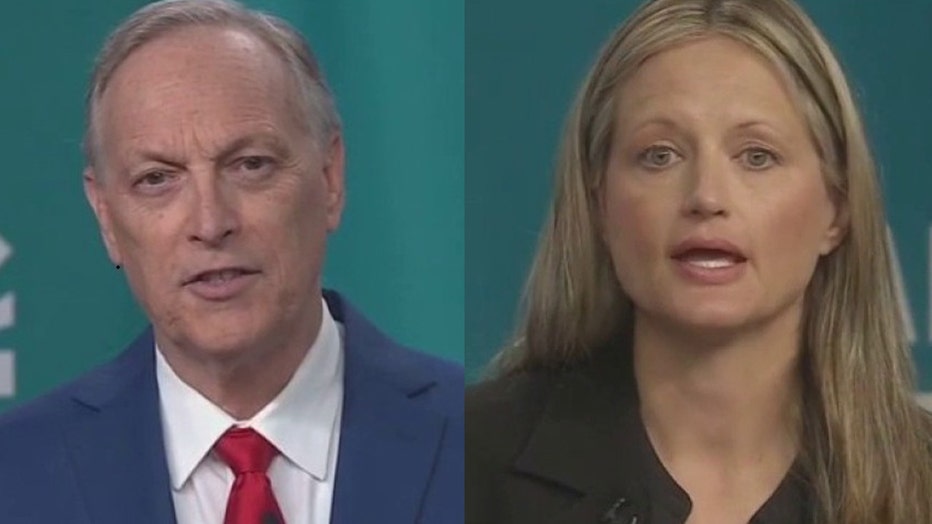
The Citizens Clean Elections Commission hosts a gubernatorial debate featuring Andy Biggs and Teri Hourihan on Oct. 6, while Governor Katie Hobbs declines to participate.
Candidates clash
Debate Recap:
Hourihan opened by challenging Biggs' legislative effectiveness, arguing that tax records and public data show he has passed only one bill despite sponsoring thousands. She pointed to taxpayers providing nearly $2 million toward his compensation over his career and questioned the return on that investment.
Addressing affordability and family support, Hourihan advocated for establishing universal child care, pointing to New Mexico's eight-year phased rollout as a potential model that could fit into the state budget without overburdening resources. She emphasized that rural regions, specifically pointing to Apache and Navajo counties, suffer under current policies that revoke benefits as soon as low-income residents secure employment. Hourihan urged reform for state assessment tools to expand child care funding, noting that present waitlists leave eligible families without options.
Biggs defended his record in Congress, attributing key bipartisan legislation to his tenure despite floor procedures listing other primary sponsors. He cited his leadership on the AMBER Alert in Indian Country Act alongside former Sen. John McCain, the JACK Act with Rep. Hakeem Jeffries to target government corruption, and the Right to Try Act with Sen. Ron Johnson.
Biggs explained that legislative customs often dictate deferring sponsorship to senior members during chamber swaps, asserting that his focus has remained on advancing single-line item budget proposals to curb federal overspending.
On fiscal management, Biggs proposed eliminating the state income tax incrementally, arguing that historic tax cuts stimulate economic momentum and ultimately generate higher tax revenues. He pointed to economic growth following the 2017 federal tax cuts as evidence that tax reductions expand the revenue base. To offset state costs and balance budgets, Biggs pledged to launch a Department of Government Efficiency program aimed at eliminating waste, fraud, and abuse.
Health care funding
The conversation shifted to healthcare funding, where Biggs highlighted significant fraud within Medicaid programs, specifically targeting single, able-bodied adult coverage. He criticized current management under Gov. Katie Hobbs, warning that delayed audit filings put nearly $18 billion in federal funds for Arizona's AHCCCS program at risk. Biggs asserted his past opposition to Medicaid expansion was rooted in accurate predictions regarding cost overruns and enrollment surges, maintaining that aid should be carefully targeted to those who truly qualify.
Hourihan rejected Biggs' claims regarding Medicaid fraud, contending that federal health funding cannot legally be redirected into the state's general fund or utilized for broad income tax cuts. She expressed alarm over potential reductions to community mental health, addiction treatment, and services for children with disabilities, arguing that trimming healthcare allocations would harm vulnerable residents and healthcare providers across Arizona.
Water issues
Addressing natural resources, Biggs defended his work securing federal mitigation funds from the Bureau of Reclamation alongside Rep. Greg Stanton to protect lower Colorado River basin allocations. He stated that Arizona holds roughly 660 million acre-feet of underground water storage capable of supporting up to 15 million residents for centuries if properly treated and distributed. Biggs advocated for expanding infrastructure, enhancing water recycling, building additional storage at locations like Bartlett Dam, and exploring desalination.
Hourihan argued that long-term litigation slows progress on water security and called for stricter, state-wide conservation standards alongside local desalination projects. She emphasized the need to expand municipal water connections in rural communities and ensure well safety, pointing to Nevada's conservation practices as an example Arizona should adopt.
Data centers
On technology infrastructure, Hourihan criticized recent state policy imposing a pause on sales tax incentives for data centers, calling the measure inadequate because it failed to stop a rush of over 100 new applications. She proposed a temporary moratorium on new data center applications on her first day in office to assess their impact on local energy grids, water supplies, and community mental health, while clarifying that current operations and existing jobs would continue uninterrupted.
Biggs advocated for a complete end to all state tax breaks and subsidies for data centers, noting that developers no longer expect tax incentives to construct facilities. He called for clear state rules barring data centers from pulling power or water away from residential and commercial customers, while noting that advancements in closed-loop cooling technologies reduce water demands. Biggs emphasized that final zoning choices should remain with local municipalities, allowing communities to determine whether data centers fit their local economic priorities.
Who are the candidates?
Andy Biggs
Biggs is the incumbent Congressman for Arizona's 5th Congressional District. Per his biography on his Congressional website, he was elected to Congress in 2016, and served in the Arizona State Legislature prior to his time in Congress.
On his issues page of his campaign website, Biggs states he supports, among other things:
- Eliminating the state income tax and "working with local entities to reduce the property tax burden."
- Lower fuel prices by reducing the state's reliance on California, and increasing fuel supplied to Arizona from other sources
- "Ending medical mandates and ensuring vaccine freedom"
Teri Hourihan
Per her campaign website, Hourihan was born and raised in Glendale, and she became a Licensed Professional Counselor in 2017, founding a health practice a year later.
Some of her political positions include:
- A moratorium, or temporary stop, on data centers as a way to ensure these new developments "protects Arizona's water, energy, and communities."
- Conducting a "comprehensive audit across Arizona agencies, systems, and political nonprofits to identify fraud, waste, abuse, and conflicts of interest."
- Launching a water security plan on day one of her administration that expands conservation, recycling and new water supplies.
Risa Lombardo (did not end up attending)
Lombardo's campaign website does not list any of her political positions. Rather, it lists what is described as the Four Pillars of the Green Party, as well as the party's key values.
In addition, Lombardo's campaign has not posted on her Facebook page since Aug. 31.
Dig deeper:
While Lombardo is listed as the Green Party candidate for governor, the Arizona Green Party's website has her candidacy listed as "actively opposed."
Per a statement released on Aug. 31, the Arizona Green Party asked Arizona's Secretary of State to remove Lombardo from the general election ballot, and replace her with a candidate they actually endorsed. The party said in late 2025, they raised questions publicly about Lombardo and a number of other candidates seeking party nominations, stating that these candidates were unknown to the party, and had not previously been involved with their group.
What about Governor Katie Hobbs?
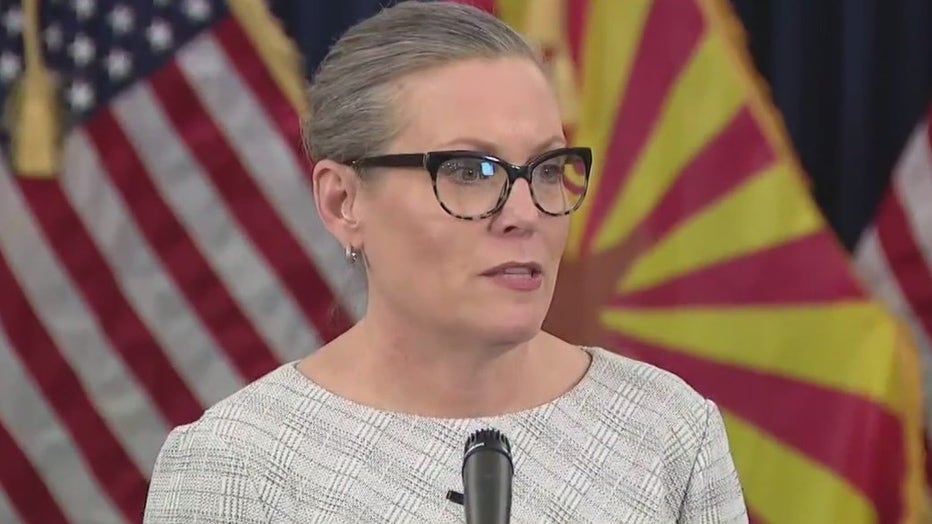
Katie Hobbs
Governor Hobbs did not take part in the debate.
The backstory:
This is not the first time Gov. Hobbs declined to take part in a gubernatorial debate. In 2022, the Associated Press reported that Hobbs, who was then running for what is now her first term in office, announced that she would not take part in that year's debate. She also didn't debate her primary opponent in that year's election, Marco Lopez.
Are there other candidates in the race?
According to the Arizona Secretary of State's Office, there are two write-in candidates who identify as Republicans: Gertritrude Gonzalez and Alice Novoa. Neither were listed as having been invited to take part in the debate.
When is the general election?
The general election takes place on Nov. 3 this year. The deadline to register to vote was Oct. 5, meaning it is now too late to register to vote in the November election.
Timeline:
The Arizona Secretary of State's Office lists the following timeline for voting:
- Start of early voting and mailing of early ballots: Oct. 7
- Deadline to request ballot-by-mail: At least 11 days before Election Day
Featured
Arizona 2026 voter checklist: Important deadlines, ID rules, and voting options
Everything you need to know to make your voice heard. Get the facts on mail ballot cutoff dates, emergency voting hours, and reporting election violations.
The Source: Information for this article was gathered from the Citizens Clean Elections Commission's website, the website for Andy Biggs, Teri Ann Hourihan and Risa Lombardo, the website for the Arizona Green Party, and an article published by the Associated Press on Sept. 11, 2022.