

2026 Election debate: Arizona state treasurer debate highlights key investment differences
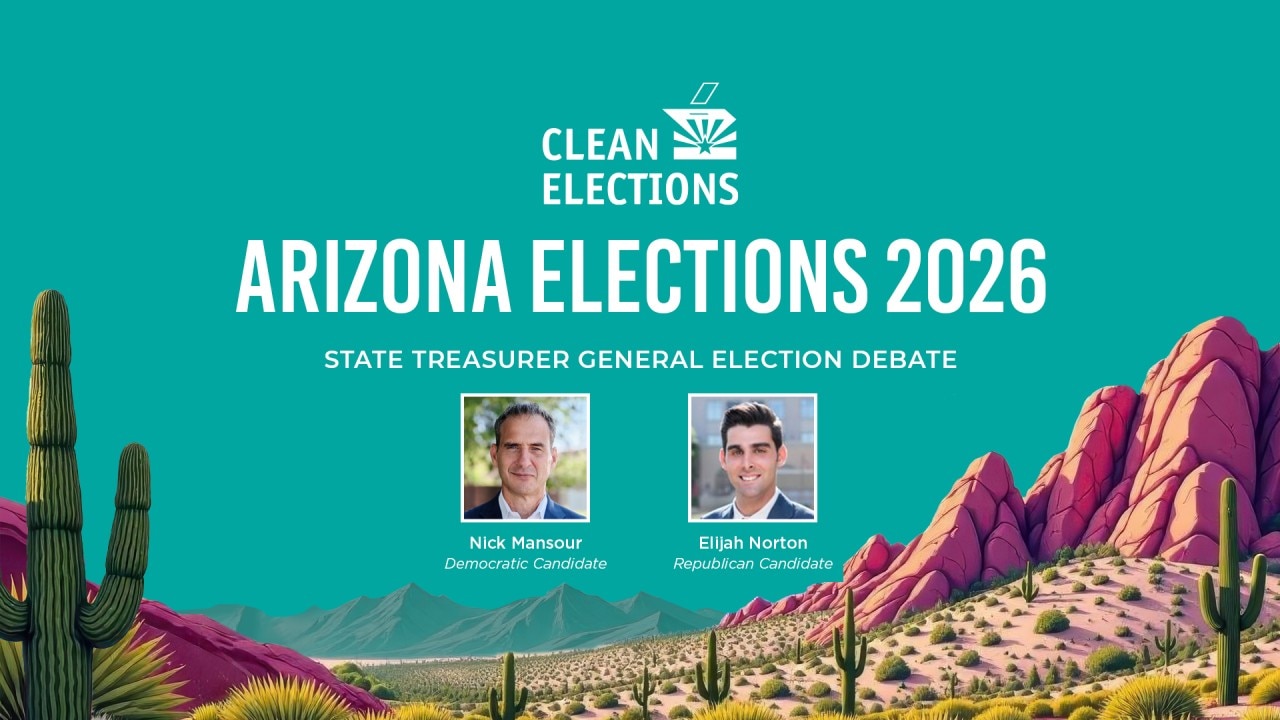
Mansour, Norton debate for Arizona state treasurer
Democrat Nick Mansour and Republican Elijah Norton faced off in a debate sponsored by the Citizens Clean Elections Commission ahead of the Nov. 3, 2026, general election.
PHOENIX - The two candidates running to become Arizona's next treasurer faced off in a debate on Wednesday, Sept. 23.
What is the treasurer's role?
As the state’s chief banking and investment agency, the Arizona Office of the State Treasurer oversees state financial assets, offers investment management for local governments, and serves as the sole trustee of the Permanent Land Endowment.
Currently, Republican Kimberly Yee is serving as the state's 36th treasurer. She's running to become Arizona Superintendent of Public Instruction after defeating incumbent Tom Horne in the Republican primary.
Who took part in the debate?
Democrat Nick Mansour and Republican Elijah Norton took part in the debate.
A recap of the debate
Introductions
Mansour focused his message on inflation and economic opportunity, stating that economic strain is top of mind for voters. He proposed leveraging Arizona's $11 billion endowment fund to generate higher returns, arguing that the state is missing out on hundreds of millions of dollars annually due to current investment strategies. Mansour also pledged to attract higher-paying jobs, eliminate waste in state tax spending, and keep partisan politics out of the treasurer's office.
Highlighting his experience managing hundreds of millions of dollars and more than 1,500 employees at Arizona College, Mansour pointed to his track record leading one of the state's top nursing programs. He added that his campaign has earned endorsements from over 100 business leaders as well as more than 50 Republican and independent figures.
Norton emphasized his background as an entrepreneur, noting that he founded a global insurance organization at age 21 that now generates over $500 million annually and manages more than $100 million in claims reserves. He said his run for office is motivated by a desire to give back to the state and country where he built his success.
Outlining his policy priorities, Norton pledged to keep political influence out of state investments by focusing strictly on safe, low-risk assets. He also called for comprehensive audits to curb fraud, waste, and abuse in state government, while placing a specific focus on improving housing affordability for younger generations, including millennials.
Managing billions of dollars
Norton emphasized the fundamental rule of state treasury management, declaring that "the treasurer's motto is very simple: safety over liquidity and liquidity over yield."
Managing $34 billion in total assets under management—including the $11 billion endowment—Norton defended the state's current allocation of 60% stocks and 40% bonds, noting a 9% to 10% return over the past year. He argued that the heavy bond presence serves as vital security against stock market downturns, pointing out that conservative management helped Arizona weather both the dot-com crash and the 2008 financial crisis without significant losses.
Norton criticized Mansour’s proposal to shift the allocation closer to 80% stocks and 20% bonds.
"You just heard in my opponent's opening statement that he wants to take a giant risk by investing," Norton said, alleging that an analysis showed a market downturn could cost the state between $1 billion and $2 billion over a decade. "This is not a risky strategy that Arizona can afford ... This isn't venture capital. This is our state's money."
Norton added that county treasurers from eight of Arizona's 15 counties released a letter opposing Mansour's proposal.
Mansour countered by agreeing with the principle of "safety first, liquidity second, and yield third," particularly for the $22 billion held for daily cash operating needs. However, he argued that maintaining the status quo on the $11 billion endowment fund is financially irresponsible.
Mansour noted that at least 10 other red and blue states—including Texas, Utah, Wyoming, New Mexico, and Oregon—have already adopted higher equity allocations.
"There's bipartisan agreement not to do what Arizona does, and the cost is huge," Mansour said. "We have lost out on $3.6 billion over the last 13 years. Instead of being $11 billion, this could be $15 billion fund today."
Mansour defended his plan to adjust the portfolio toward a 70/30 or 80/20 stock-to-bond ratio, framing it as a standard, expert-backed strategy for long-term growth.
"It's not a big bet. And over the long term, we will make more money and that's what we should be doing," Mansour said. "This is a fund for education. I am a parent. Our education is ranked very low ... This is a way for us to invest for the long term, to make more money for our kids and to keep our taxes low."
Back up plan in case of an economic downturn
Mansour defended the treasury's current management of $22 billion in daily cash funds while accusing Norton of planning radical staffing changes that would create instability.
"Elijah is on record attacking Kimberly Yee for doing an abysmal job," Mansour said, referring to incumbent Treasurer Kimberly Yee. "He's called her a figurehead and her people ... political hacks, and he wants to fire them all. So if you want to talk about risk, firing all the political appointed people in this office day one will add a lot of risk."
Mansour also argued that Norton’s investment approach would inject partisan politics into portfolio management by disqualifying a vast majority of major corporations. He claimed Norton’s criteria would force the state to avoid investing in more than 400 Fortune 500 companies, warning it would increase risk and lower returns.
Hitting Norton on party backing, Mansour claimed the Republican lacks trust within his own party, noting Yee did not endorse him and recruited a primary challenger against him, alongside a letter from 36 Republican leaders expressing distrust. Mansour pointed to his own endorsements from over 100 business leaders and more than 50 Republicans and independents.
Norton fired back, dismissing Mansour's claims about party support and highlighting his primary victory.
"The assertion that I'm not trusted by members of my own party is ludicrous," Norton said, citing endorsements from the majority of Republican county treasurers, the speaker of the state House, the state Senate president, 20 current or former legislators, Barry Goldwater Jr., and former Ambassador Donald Tapia.
Norton pushed back against Mansour’s earlier references to other states' investment models, stating an analysis by a former advisor to former Gov. Doug Ducey showed Texas holds only 25% of its endowment assets in stocks, alongside private equity and land holdings.
Turnabout on the issue of political investing, Norton accused Mansour of pushing an ideological agenda after allegedly telling local officials he would divest state funds from oil in favor of green energy.
"We've made a 277% return on the $190 million worth of oil stocks we've had," Norton said, comparing that to a 4% annualized five-year return on $40 million in green energy stocks. "He wants to actually engage in political ideology in our investments, and it will cost us money."
Norton emphasized a strictly profit-driven investment philosophy moving forward.
"I don't care if a company is left or right aligned. I care that they're making money," Norton said. "This office isn't red or blue. It's green. I don't mean the Green Party. I mean it's green in terms of money."
Nick Mansour (Democrat)
An Arizona native, entrepreneur, husband, and father of four, Mansour previously founded a leading nursing school to help address the state’s healthcare worker shortage.
Mansour says he's running for state treasurer to safeguard taxpayer dollars, eliminate government waste, and invest responsibly. He says rather than using the office as a political stepping stone, he aims to strengthen Arizona’s economy and support public education to ensure local families thrive.
Elijah Norton (Republican)
Phoenix businessman, Norton, a Republican running for treasurer, says he plans to bring private-sector financial discipline to state public funds.
Norton, who built an Arizona-headquartered finance and insurance firm from $1,000 in savings, previously served as treasurer for the Arizona Republican Party, where he oversaw budgeting, auditing, and fiscal compliance.
If elected, Norton says he pledges to reject environmental, social, and governance (ESG) strategies, focus on maximizing investment returns, and eliminate waste in state financial management.
Who organized the debate?
The Citizens Clean Elections Commission is the official debate sponsor.
When is the general election?
The general election will take place on Nov. 3, 2026, and the deadline to register to vote in that election is Oct. 5.
What you can do:
To register as a voter, you can visit the Secretary of State's website. For additional voter information, click here.