

Ciscomani, Mendoza debate economy, taxes in Arizona CD-6 race debate

CD-6 candidates debate economy, inflation
Republican Juan Ciscomani and Democrat JoAnna Mendoza debated inflation, taxes, and safety-net programs in Arizona's 6th Congressional District debate on Sept. 10.
PHOENIX - The Republican and Democratic candidate for Arizona's 6th Congressional District took part in a debate on Sept. 10, and here's what to know.
What parts of the state does CD6 cover?
According to a map on Congress.gov, Arizona's 6th Congressional District covers portions of Southeastern Arizona, including Sierra Vista and parts of Casa Grande and Tucson.
Who organized the debate?
The Citizens Clean Elections Commission is the official debate sponsor.
Who took part in the debate?
Republican Juan Ciscomani took on Democrat JoAnna Mendoza in the debate.
Juan Ciscomani
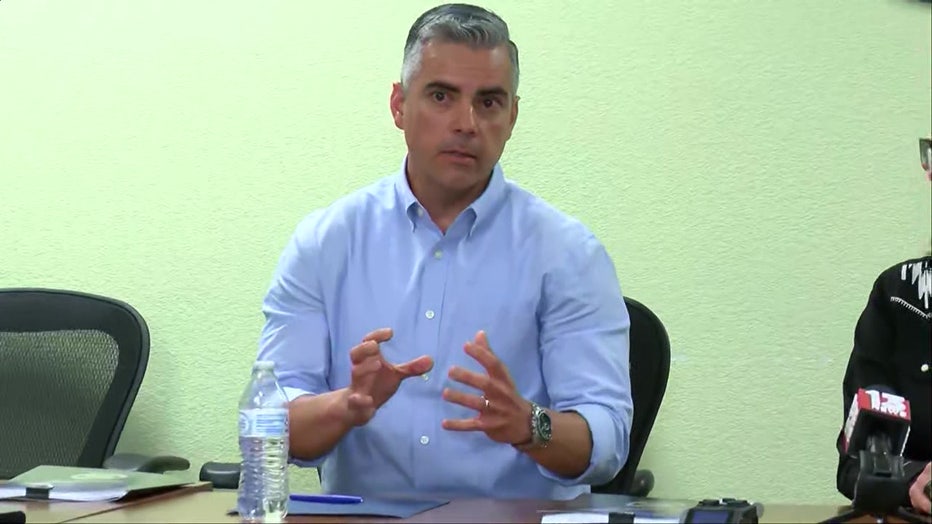
Juan Ciscomani
Ciscomani is the incumbent congressman for the district: per his biography on his Congressional website, Ciscomani was first elected to the post in 2022, and he claims to be the first naturalized U.S. citizen from Mexico in Arizona history to be elected to the U.S. House of Representatives.
Per his Congressional website, Ciscomani worked for the University of Arizona, the Tucson Hispanic Chamber of Commerce, as well as serving as Senior Advisor of the Arizona-Mexico Commission before his congressional career.
JoAnna Mendoza
According to her campaign website, Mendoza enlisted in the U.S. Navy at the age of 17 before joining the U.S. Marine Corps. During her 20-year military career, Mendoza said she was a drill instructor, and was deployed to Afghanistan and Iraq.
On the issues, Mendoza said she will work to stop what she called "unfair price disparities in rural communities" and strengthen consumer protections as a way to lower costs. She also said she will bring back town hall events within her first 100 days as a congresswoman, and work to strengthen border security.
Recapping the debate
Ciscomani highlighted his personal background as a father of six, youth football coach, and proud immigrant representing his community in Congress. Reflecting on marking 20 years as a United States citizen, Ciscomani expressed his strong belief in the American dream, emphasizing that his tenure in Congress has focused on achieving results rather than rhetoric.
He stated that he has been independently ranked as the most bipartisan member in Arizona for every year he has served in office. Shifting focus to his challenger, Ciscomani described her background as one tied to lobbying, dark money, and special interests. He further alleged that she supports raising taxes while failing to pay her own, and noted her endorsement by defund the police advocates—a record he claimed she is actively attempting to avoid.
Mendoza presented a contrasting journey rooted in agricultural labor and military duty. As the daughter of farmworkers, she recalled laboring alongside her parents in cotton fields every summer during her youth. To escape rural poverty, she enlisted in the military at age 17, serving first in the Navy and later in the Marine Corps. Her two-decade military career featured combat deployments to Iraq and Afghanistan, as well as service as a Marine Corps drill instructor training future service members. Explaining her decision to run for office, Mendoza stated that local families are currently struggling, prompting her to answer the call to serve once again under an oath to protect the country and uphold the Constitution that she considers lifelong.
Affordability
When asked about the single most important action Congress can take to lower costs for Arizona’s 6th Congressional District, the candidates offered opposing approaches to government spending, taxes, and economic policy.
Ciscomani said inflation and rising prices remain top concerns for local families, pointing to peak inflation under the Biden administration as the root of current financial strain. To address affordability, Ciscomani opposed higher taxes, increased government involvement, and expanded federal programs, emphasizing that recent legislation aimed at putting money back into taxpayers' pockets is the proper approach.
Mendoza said government assistance programs like food stamps and AHCCCS are vital safety nets for working families, citing personal experience growing up in a farmworker family. Mendoza criticized Ciscomani’s vote for H.R. 1, arguing that the accompanying program cuts increased costs for residents and reduced access to nutrition for children. Additionally, Mendoza noted that Ciscomani voted nine times in favor of tariffs, which Mendoza said are driving up prices across the board.
Big Beautiful Bill and its impact
When asked about the One Big Beautiful Bill and its impact on Arizonans in the form of reduced SNAP benefits and AHCCCS, the candidates offered opposing perspectives on tax cuts, safety-net programs, and economic relief.
Ciscomani stated that strengthening the family safety net was the primary priority of the bill. Pointing to the Working Families Tax Cuts Act, Ciscomani highlighted three main provisions designed to benefit working families: eliminating taxes on overtime pay, eliminating taxes on tips, and extending and making permanent the child tax credit. Ciscomani argued that opposing the legislation meant opposing these specific tax benefits for families.
Mendoza criticized Ciscomani’s framing as dishonest, stating that the opponent left out the full statement calling for an end to tax cuts for billionaires. Mendoza argued that lowering costs requires reversing billionaire tax breaks passed in H.R. 1, ending price-raising tariffs, and reinstating funding for programs like SNAP, which Mendoza relied on while growing up.
Aren't there other candidates in the race?
While only Ciscomani and Mendoza will take part in the Clean Elections debate, there are a total of five candidates in the election, with the other three being:
- Michael Dorland (Independent, write-in candidate)
- Jereme Lance Peters (Libertarian Party)
- Gary Swing (Green Party)
Michael Dorland
Per his nomination papers, Dorland is a 57-year-old who lives in Tucson. In his statement on the Secretary of State's website, Dorland wrote that he "know what it looks like when a reasonable-sounding policy destroys someone's life," and that he is running for Congress because "I genuinely believe I'm unlikely to make things worse — and I'll say so when I do."
"I'm not claiming to be the most qualified person, I'm saying the bar is low, and honest incompetence acknowledged beats confident incompetence concealed," Dorland wrote.
Jeremy Lance Peters
Not much is known about Peters, but according to his nomination papers, Peters is a 38-year-old who resides in Tucson.
Gary Swing
Swing, according to his nomination paper, is a 58-year-old who resides in Tucson. His statement on the Secretary of State's website contains mentions to his political beliefs, which includes, among other things, "abolish nuclear weapons," "reduce US military budget [by] 90%," abolishing the U.S. Senate, and "Impeach and convict Trump and his entire cabinet."
Isn't there a debate for the CD2 candidates as well on Sept. 10?
According to the Citizens Clean Elections Commission's website, a debate was supposed to take place on Sept. 10 for two Congressional District 2 candidates: Republican Eli Crane and Democrat Jonathan Nez. However, the website shows that Crane did not respond to an invitation to attend the debate.
A third candidate, Curtis Goodwin of the Libertarian Party, did not appear on the list of candidates invited on the commission's website.
The commission is known to conduct candidate interviews in lieu of debates when only one candidate agrees to participate, such as the Sept. 1 interview with Miranda Lopez, a Democrat who is running to represent the state's 21st Legislative District in the state house. A similar interview was done with Nez.
When is the general election?
The general election will take place on Nov. 3, according to the Secretary of State's Office.
The Source: Information